
One day, a client booked a call through our website.
You could tell within the first few minutes — they were frustrated.
Not the “I need better ads” type of frustration.
More like:
“I’ve tried everything… nothing is working.”
They had worked with multiple agencies, tested different funnels, and spent a decent amount on ads.
At one point, they were even considering quitting the coaching space.
What they were doing before
When we started breaking things down, a pattern showed up.
They weren’t doing “nothing.”
They were doing too many things without clarity.
Free webinar funnel
This gave them volume.
Leads were coming in. Registration numbers looked good.
But when we asked:
“How many of them actually buy?”
The answer was… almost none.
Most people joined because it was free.
They consumed content and left.
₹99 masterclass funnel
So they tried charging.
And yes — this improved lead quality.
But now a different issue showed up.
Cost per acquisition went up.
Margins got tight.
Scaling felt risky.
Every new campaign felt like:
“Let’s see if this works… again.”
Where they were stuck
They were bouncing between two extremes:
Free → lots of leads, no buyers
₹99 → buyers, but expensive and unstable
❌ No predictability. ❌ No system.
Just constant switching.
What we changed
We didn’t try to “fix” the ₹99 funnel.
We replaced the entry point.
👉 ₹9 masterclass
Simple shift. Big difference.
Why ₹9 worked
At ₹99, people think.
At free, people don’t care.
₹9 sits in between.
It’s low enough to remove hesitation, but high enough to keep intent.
That’s what changed user behavior.
We also simplified the funnel
This part is underrated.
Most funnels have unnecessary steps.
Landing pages, long forms, multiple clicks.
We removed all of it.
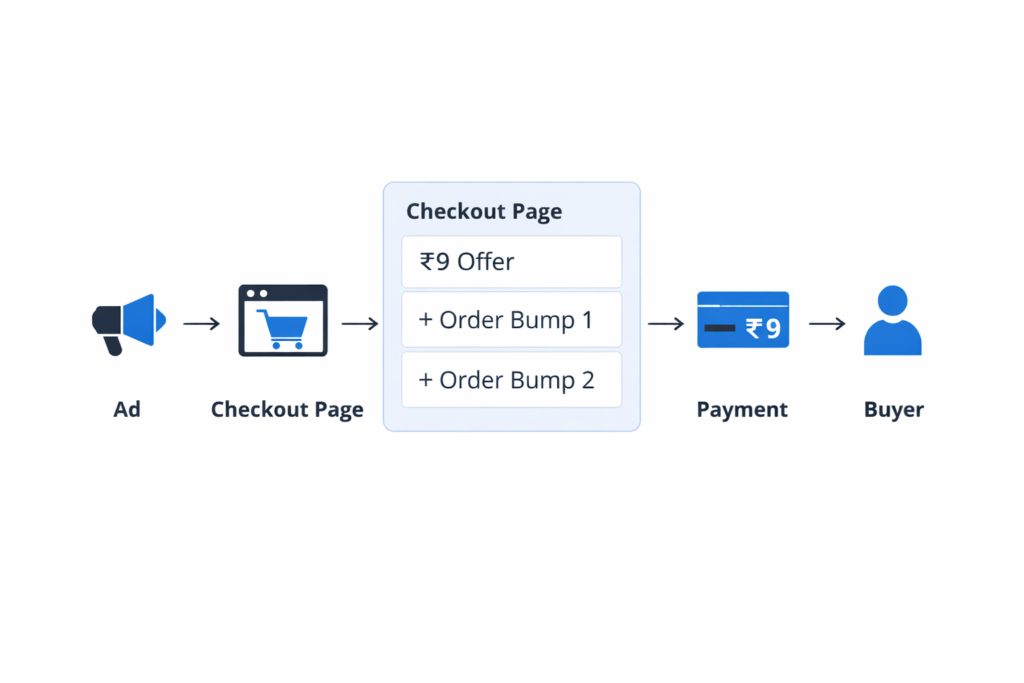
The flow became:
Ad → Checkout Page → Payment
That’s it.
No friction. No distraction.
The part that actually made money
If you think ₹9 made this profitable, you’re wrong.
The real lever was average order value (AOV).
We added 2 order bumps directly on the checkout page.
Nothing complicated. Just relevant add-ons.
This pushed the numbers up.
👉 Around 50% of ad spend was recovered upfront
Now we weren’t depending entirely on backend sales.
The numbers (what actually happened)
Once the funnel stabilized, here’s what we saw:
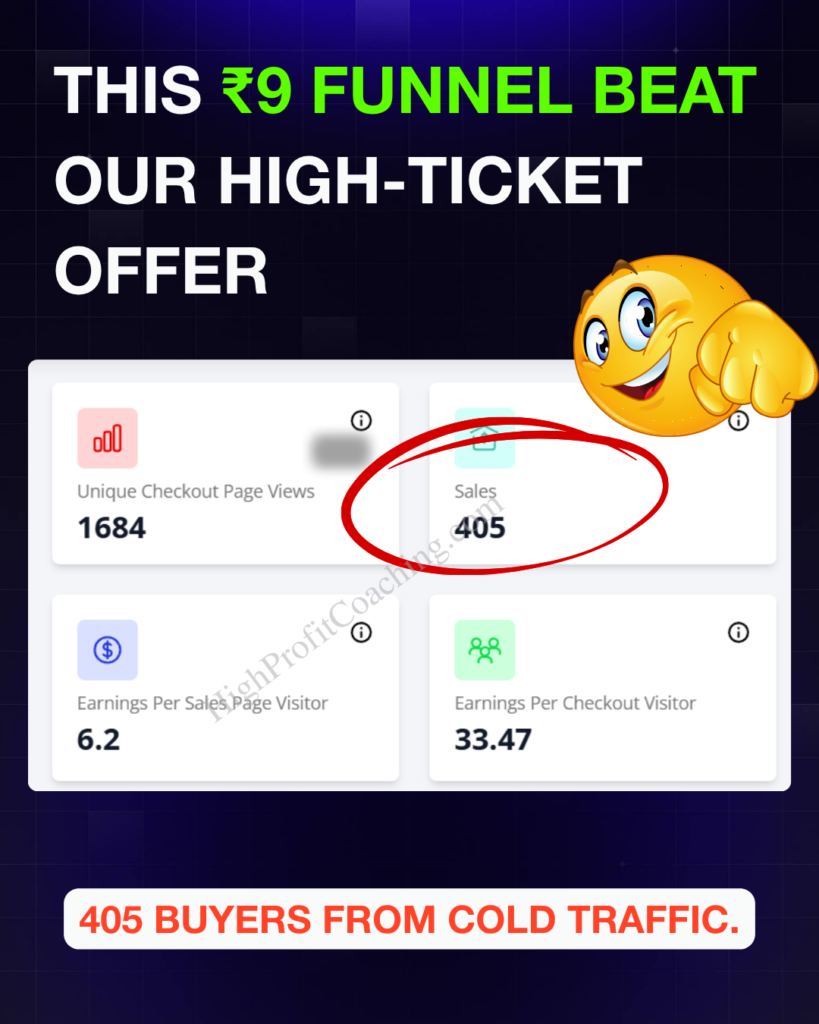
Checkout Page Views: 1,684
Total Buyers: 405
Conversion Rate: ~24%
On top of that:
Earnings Per Visitor: ₹6.2
Earnings Per Checkout Visitor: ₹33.47
Most funnels sit around 3–5% conversion.
This one hit ~24%.
That’s not a small improvement.
That’s what happens when the structure is right.
Why this worked (no fluff answer)
No tricks. No hacks.
Just fundamentals done properly:
Right entry price
Paid = better intent
Fewer steps = higher completion
Order bumps = better economics
That combination is what made it work.
What most people will do after reading this
They’ll copy ₹9.
Ignore everything else.
Then say:
“Didn’t work for me.”
Because they didn’t fix:
the offer
the positioning
the funnel flow
Price alone won’t fix a broken funnel.
Final takeaway
Before this, they were generating leads.
After this, they were generating buyers.
That one shift made everything easier:
backend sales
follow-ups
scaling ads
What is a masterclass funnel and how does it work?
A masterclass funnel is a sales system where you use a training session (free or paid) to convert traffic into buyers. Instead of sending users through multiple steps, the funnel focuses on a clear outcome — attracting the right audience, building trust quickly, and converting them into paying customers. In this case, the ₹9 masterclass acted as the entry point to turn cold traffic into buyers instantly.
Why does a ₹9 masterclass funnel convert better than free or ₹99 funnels?
A ₹9 masterclass sits in the middle of two extremes. Free funnels attract low-intent users who are unlikely to buy, while ₹99 funnels create higher friction for cold traffic. At ₹9, the decision feels low-risk, so users don’t overthink, but because it’s still paid, it filters out non-serious leads. This balance improves both conversion rate and lead quality.
What is a good conversion rate for a masterclass funnel?
Most masterclass funnels convert between 3% to 10%, depending on traffic quality and offer strength. High-performing funnels can reach 15–25% when the entry price, messaging, and funnel structure are aligned. In this case study, the funnel achieved around 24% conversion, which is significantly above average.
How do order bumps increase profitability in a masterclass funnel?
Order bumps increase the average order value (AOV) by offering additional products at the checkout stage. These are usually low-friction add-ons that complement the main offer. In this funnel, two order bumps helped recover around 50% of ad spend upfront, reducing reliance on backend sales and improving overall profitability.
Is a ₹9 masterclass funnel profitable without backend sales?
In most cases, the ₹9 offer alone is not designed to generate full profit. Its purpose is to acquire buyers at low cost and recover a portion of ad spend. Profitability typically comes from a combination of order bumps and backend offers. However, a well-structured funnel can significantly reduce acquisition cost and improve cash flow from day one.
Who should use a masterclass funnel?
Masterclass funnels work best for coaches, consultants, course creators, and service providers who want to convert cold traffic into buyers. They are especially effective for businesses struggling with low-quality leads from free funnels or high acquisition costs from higher-priced entry offers.