Most coaches lose money on ads for one simple reason:
They try to sell high-ticket programs to cold traffic.
That model is fundamentally flawed.
A micro-offer funnel changes that completely.
Instead of asking a cold audience to buy a ₹50,000–₹1,00,000 coaching program immediately, a micro-offer funnel introduces a low-ticket entry offer designed to:
- Recover ad spend faster
- Convert cold traffic into buyers
- Increase trust
- Improve backend conversion rates
It’s not a discount strategy.
What Is a Micro-Offer Funnel?
It’s a monetization strategy.
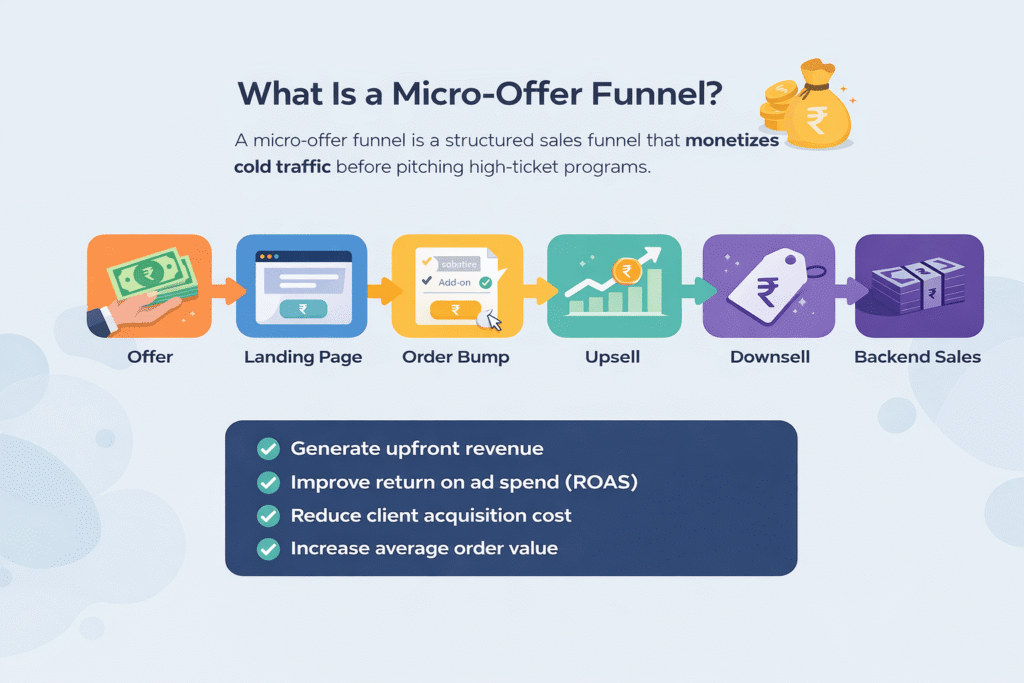
A micro-offer funnel is a structured sales funnel that monetizes cold traffic at the front end before pitching high-ticket programs.
The structure typically looks like this:
- Offer
- Landing Page
- Order Bump
- Upsell
- Downsell
- Backend Sales
Instead of hoping backend sales make you profitable, the funnel is designed to:
- Generate upfront revenue
- Improve return on ad spend (ROAS)
- Reduce client acquisition cost
- Increase average order value
This is performance-first funnel design. To understand why this structure matters, you need to see where most coaches go wrong.
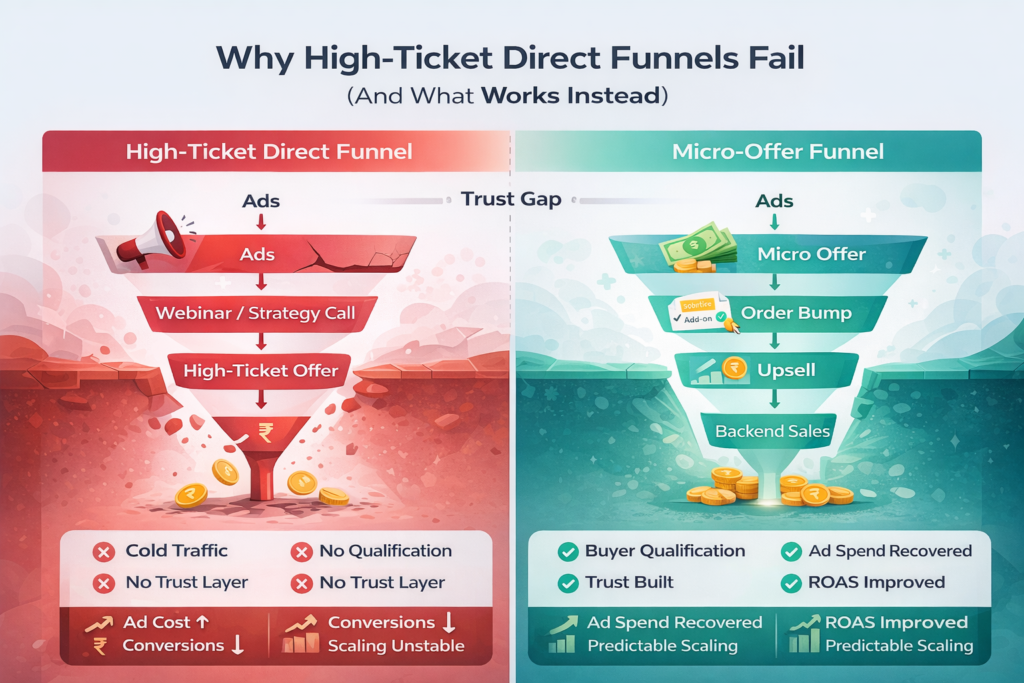
Why High-Ticket Direct Funnels Fail for Coaches
Most coaches run ads directly to:
- Free webinar
- Strategy call
- High-ticket application
The problem?
Cold traffic doesn’t trust you yet.
Without:
- Buyer qualification
- Trust building
- Entry-level monetization
Ad costs rise. Conversions drop. Scaling becomes unstable.
That’s where the micro-offer funnel creates leverage.
How a Micro-Offer Funnel Recovers Ad Spend Faster
Micro-Offer Funnel Example: Offer in a Day Case Study

A micro-offer funnel is not theory for us.
We don’t just build and run campaigns for clients.
Whenever we create a new method or system, we install and launch it on our own offers first.
When we launched our own micro-offer funnel — Offer in a Day — we validated the model internally before scaling it externally.
What Happened
Within the first launch phase:
• 15–20 buyers per day
• Ad spend recovered the same day
• 1.5X upfront ROAS during optimized campaigns
• Profitable scaling within the first week
Instead of relying on backend high-ticket sales to “hopefully” make ads profitable, the front-end funnel was structured to monetize immediately.
That changed everything.
If ₹10,000 was spent on ads,
₹14,000–₹15,000 was recovered through front-end sales and upsells — before backend offers were introduced.
Now backend sales became additional profit — not the only dependency.
That’s the difference between campaign management and revenue engineering.
And that fundamentally changes the psychology of paid traffic.
Ads stop feeling risky.
They start feeling scalable.
At High Profit Coaching, we help coaches, consultants, and course creators launch micro-offer funnels that can generate 10–15 buyers per day without burning money on ads. As a growth-focused marketing agency for coaches, we build structured systems designed for profitable scaling. That’s the power of a Micro-Offer Funnel — it turns traffic into predictable revenue.
Key Components of a High-Performing Micro-Offer Funnel
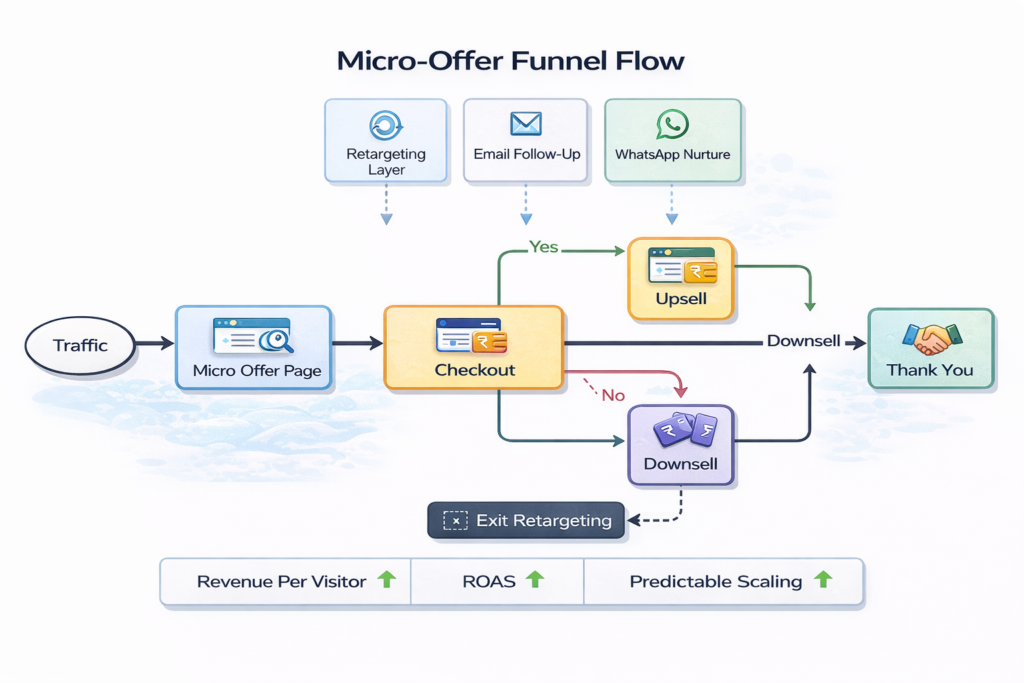
A micro-offer funnel is not a cheap product with ads behind it.
It’s engineered monetization.
Here’s how we structure it — and we test it on our own offers before rolling it out for clients.
1. Clear Offer Positioning
One painful problem. One sharp outcome. No confusion.
2. Conversion-Focused Landing Page
Built for cold traffic. Strong headline, proof, and clear call to action.
3. Order Bump
Small add-on. Instant lift in average order value. Easy profit lever.
4. Add Upsell
If your funnel doesn’t include an upsell, you’re leaving money on the table. Upsells increase average order value and lower your cost per acquisition. Simple. More revenue per buyer means more scalable ads.
5. Downsell Recovery
If they reject the upsell, we don’t lose them. We recover revenue.
6. Backend Monetization
High-ticket comes after trust and transaction. Not before.
Every layer compounds.
The goal is simple:
Higher revenue per visitor.
Faster ad spend recovery.
Predictable scaling.
This is why micro-offer funnels work — and why most direct high-ticket funnels fail.
Why the Micro-Offer Funnel Works Especially Well in India
In the Indian coaching market:
- Buyers are price-sensitive upfront
- Trust is critical before high-ticket sales
- WhatsApp follow-ups dominate conversions
A micro-offer funnel reduces friction. Instead of asking for a large commitment immediately, it builds buyer momentum. That momentum improves backend closing rates significantly.
Who Should Use a Micro-Offer Funnel?
Ideal for:
- Coaches earning ₹3L+ per month
- Course creators running paid ads
- Consultants with validated offers
- Brands wanting predictable client acquisition
Not ideal for:
- Unvalidated offers
- No product-market fit
- Coaches without backend programs
The funnel amplifies structure. It doesn’t fix weak offers.
Here’s What Most Coaches Get Wrong
Most coaches think scaling means increasing ad spend. It doesn’t. Scaling means increasing revenue per visitor. Traffic only amplifies what’s already there — if the funnel is weak, you lose money faster; if the funnel is structured, you scale profitably. A micro-offer funnel fixes the foundation first by monetizing cold traffic, building trust through transaction, and increasing average order value before pushing high-ticket.
Traffic amplifies structure.
If the structure is weak, you scale losses.
If the structure is strong, you scale profit.
Frequently Asked Questions About Micro-Offer Funnels
What is a micro-offer funnel?
A micro-offer funnel is a structured sales funnel that monetizes cold traffic upfront before pitching high-ticket programs. Instead of relying only on backend sales, it generates revenue immediately through a low-ticket entry offer, upsells, and downsells.
How does a micro-offer funnel work for coaches?
For coaches, a micro-offer funnel converts cold traffic into buyers first. Once a transaction happens, trust increases. That improves backend high-ticket conversions and reduces dependency on strategy calls or webinars.
Is a micro-offer funnel better than a high-ticket direct funnel?
For cold traffic, yes. High-ticket direct funnels rely heavily on trust that doesn’t exist yet. A micro-offer funnel builds buyer momentum first, increases average order value, and recovers ad spend faster.
Can a micro-offer funnel recover ad spend quickly?
Yes — when structured properly. Through front-end sales, order bumps, and upsells, ad spend can be recovered the same day in optimized campaigns. Backend offers then become additional profit, not the only source of revenue.
What should a micro-offer cost?
A micro-offer should be low enough to remove friction but valuable enough to solve a specific problem. The goal isn’t discounting — it’s monetizing cold traffic and increasing revenue per visitor.
Do micro-offer funnels work in India?
Yes, especially in the Indian coaching market where upfront price sensitivity and trust barriers are common. A micro-offer reduces friction and improves conversion rates before presenting high-ticket programs.
Who should use a micro-offer funnel?
Anyone launching or scaling an online coaching business and running paid traffic. If you want predictable buyers, faster ad spend recovery, and structured growth, this model fits. But it won’t fix a weak offer. Systems scale strength not confusion.
Is a micro-offer funnel the same as a webinar funnel?
No. Webinar funnels usually depend on backend conversion. A micro-offer funnel generates upfront revenue and builds buyer trust through transaction before scaling high-ticket sales.
What is the biggest mistake coaches make with funnels?
Most coaches push high-ticket offers directly to cold traffic without qualification, trust building, or monetization layers. That increases ad costs and reduces scalability.
Why is revenue per visitor more important than ad spend?
Scaling isn’t about increasing traffic. It’s about increasing revenue per visitor. When revenue per visitor increases, scaling becomes predictable and profitable.